
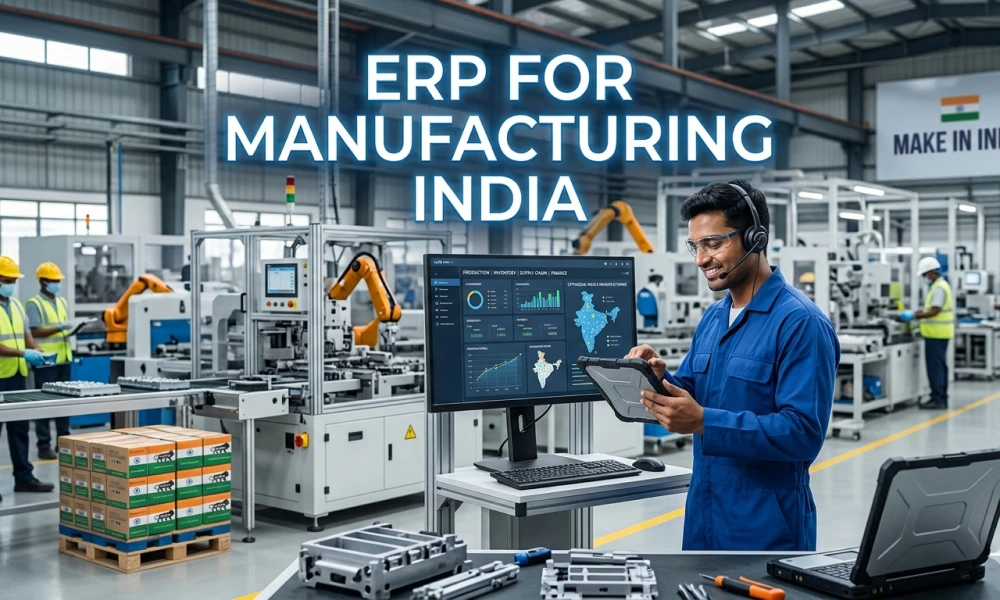
Manufacturing businesses in India are rapidly evolving, and adopting the right technology is essential for growth and efficiency. ERP for manufacturing India helps streamline complex operations such as production planning, inventory control, and financial management within a single platform. By using manufacturing ERP software India, companies can automate processes, reduce manual errors, and improve productivity.
Modern solutions like production management software and inventory management for manufacturing provide real-time insights for better decision-making. Whether for small factories or large industries, cloud ERP for manufacturing India ensures flexibility and scalability. Implementing an effective ERP system allows manufacturers to optimise resources, enhance supply chain efficiency, and stay competitive in today’s dynamic market.
What is ERP for Manufacturing in India?
Definition of Manufacturing ERP
Manufacturing ERP software is an integrated business management platform that connects all core operations of a manufacturing company — production planning, inventory management, procurement, quality control, sales, finance, and compliance — into one unified system with a shared real-time database.
Unlike generic accounting tools or standalone factory management software, a full manufacturing ERP covers the entire manufacturing lifecycle: from raw material procurement and Bill of Materials (BOM) management to work order execution, shop floor management, finished goods tracking, and customer delivery. Every transaction updates all connected modules simultaneously, eliminating data duplication and manual reconciliation.
Importance for Indian Manufacturers
India is the world’s sixth-largest manufacturing nation and the government’s ‘Make in India’ and PLI scheme ambitions are pushing manufacturers to increase capacity, improve quality standards, and integrate with global supply chains. To compete at this level, Indian manufacturers need real-time operational data — not end-of-day manual reports.
Beyond competitiveness, compliance is a driver too. GST e-invoicing, mandatory for businesses above ₹5 crore turnover, requires accurate, real-time transaction records that manual systems cannot reliably produce. Manufacturing ERP software makes compliance automatic rather than burdensome.
Apna ERP was built in Rajkot after identifying exactly this gap: the majority of Gujarat’s manufacturing SMEs — in sectors like pharmaceuticals, steel, food processing, plastics, packaging, clocks, toys, and printing — needed a customised ERP solution designed for their specific workflows, not a generic tool that requires expensive customisation to become useful.
Key Features of ERP for Manufacturing India
A world-class manufacturing ERP for Indian businesses must go beyond basic accounting. Here are the essential features that every manufacturer should evaluate:
Production Planning & Scheduling
Production planning is the core function that separates manufacturing ERP from all other business software. Apna ERP’s production planning module includes:
- Master Production Schedule (MPS) — plan production output by week, month, and quarter
- Bill of Materials (BOM) management — multi-level BOM for complex assemblies and sub-assemblies
- Work order creation and management — raise, approve, and track work orders from raw material to finished goods
- Shop floor management system — real-time tracking of each production stage and operator
- Capacity planning — match available machine and labour capacity to incoming orders
- Material Requirements Planning (MRP) — auto-calculate raw material needs based on production schedule and current stock
Inventory Management System
For manufacturers, inventory management spans three categories — raw materials, work-in-progress, and finished goods — each with different tracking needs. Apna ERP’s inventory management for manufacturing includes:
- Real-time stock tracking across all warehouses and production stages
- Batch and lot number tracking for pharma, food, and chemical manufacturers
- Expiry date management and FIFO/FEFO rotation enforcement
- Automated reorder point alerts and purchase requisition generation
- Barcode and QR code integration for fast goods receipt and dispatch
- Wastage and scrap tracking with cost allocation
Quality Control Management
Quality failures in manufacturing are costly — rejected batches, rework, customer returns, and compliance penalties. Apna ERP’s quality assurance system includes:
- Incoming raw material quality inspection with pass/fail recording
- In-process quality check at defined production stages
- Finished goods quality testing before dispatch
- Non-conformance reports (NCR) and corrective action tracking
- Quality test templates by product category or customer specification
- Integration with pharma compliance requirements (GMP, Schedule M)
Supply Chain Management
Manufacturing efficiency depends on reliable raw material supply. Apna ERP’s supply chain management software connects procurement to production planning:
- Supplier management with performance ratings and lead time tracking
- Purchase order creation with approval workflows
- Goods receipt note (GRN) with quality check integration
- Demand forecasting based on sales history and production pipeline
- Multi-location warehouse management for companies operating from multiple plants
- Freight and logistics tracking for inbound and outbound shipments
Benefits of ERP for Manufacturing Businesses in India
Improved Operational Efficiency
Manufacturing companies that implement a fully integrated ERP system report significant improvements in on-time delivery, production throughput, and order fulfilment rates. By automating business process automation across procurement, production, and dispatch, factory management software eliminates the manual handovers that cause delays and errors. Apna ERP clients report saving 2–4 hours per day on reporting and manual data entry alone.
Cost Reduction
Manufacturing ERP drives cost reduction through three primary mechanisms: reduced raw material waste (through accurate BOM tracking and scrap management), lower inventory carrying costs (through demand forecasting and automated reorder management), and reduced rework and rejection costs (through integrated quality control at every production stage). Real-time cost tracking and reduction visibility allows production managers to identify and eliminate inefficiencies before they compound.
Real-Time Data Insights
With Apna ERP’s user-friendly dashboard, factory owners and production managers access real-time data analytics covering machine utilisation, work-in-progress by production stage, raw material consumption vs standard, daily production output, and cost per unit — all without waiting for end-of-day manual reports. This real-time visibility is what separates manufacturers who react to problems from those who prevent them.
Better Decision Making
Strategic decisions — which products to prioritise, which suppliers to consolidate, when to invest in additional capacity — require accurate, timely data. Manufacturing ERP software provides the integrated reporting layer that management needs for better decision making. From daily production dashboards to monthly profitability analysis by product line, Apna ERP delivers the business intelligence that turns operational data into competitive advantage.
Core Modules in ERP for Manufacturing India
Apna ERP’s manufacturing ERP system is built on a modular architecture, with every module customised to match your specific production workflow:
| Module | Core Capabilities |
| Production Module | BOM management, work order creation, MRP, shop floor tracking, production scheduling, machine utilisation |
| Inventory Module | Raw material, WIP, finished goods tracking, batch/lot management, barcode integration, wastage, reorder alerts |
| Accounting & Finance | GST invoicing, e-invoicing, GSTR reports, cost accounting, P&L, balance sheet, TDS/TCS, payroll |
| CRM & Sales | Sales order management, customer database, quotation, dispatch tracking, customer-wise profitability |
| Quality Module | Incoming inspection, in-process QC, finished goods testing, NCR management, compliance tracking |
| Procurement Module | Supplier management, PO creation, GRN, approval workflow, supplier performance, cost tracking |
| HR & Payroll Module | Staff attendance, wage processing, PF/ESI, contract labour management, shift scheduling |
| Reporting & Analytics | Real-time dashboards, MIS reports, cost analysis, production efficiency, demand forecasting |
Production Module
The production module is the heart of manufacturing ERP software. Apna ERP’s production module manages the entire manufacturing lifecycle from BOM creation and material requirement planning through work order execution, shop floor management, and finished goods entry. Every stage is tracked in real time with operator-level accountability.
Inventory Module
Manufacturing inventory requires tracking raw materials, packing materials, work-in-progress at each production stage, and finished goods across one or more warehouses. Apna ERP’s inventory module for manufacturing supports multi-location stock management, batch tracking, expiry management, and automatic reorder generation to ensure production lines never stop due to material shortages.
Accounting & Finance
The finance module handles all GST invoicing, purchase accounting, production cost entries, and statutory compliance. GSTR-1 and GSTR-3B reports are auto-generated. E-invoicing with IRN generation is available for eligible businesses. Standard costing and actual costing variance analysis helps identify where production costs are exceeding targets.
CRM & Sales
The CRM and sales module manages the complete order-to-dispatch cycle: customer enquiry, quotation, sales order, production planning linkage, dispatch, and invoice. Customer-wise profitability reports help sales teams focus on high-margin accounts, while automated delivery alerts improve customer satisfaction.
Types of ERP for Manufacturing India
Cloud-Based ERP
Cloud-based manufacturing ERP software is hosted on remote servers and accessed via the internet from any device — laptop, tablet, or mobile. For multi-plant manufacturers, factory owners who travel frequently, or businesses with distributed teams, cloud ERP for manufacturing India offers real-time visibility from anywhere. Automatic updates, built-in data backup, and lower upfront infrastructure cost make cloud ERP the fastest-growing deployment model for Indian manufacturing SMEs in 2026.
On-Premise ERP
On-premise manufacturing ERP software runs on a local server at the factory or head office. It does not require internet for daily operations, making it suitable for manufacturing plants in areas with unreliable connectivity or for companies with strict data security and sovereignty requirements. Industrial ERP software for large manufacturers often uses on-premise deployment for core production systems with cloud dashboards for management reporting.
Industry-Specific ERP
Generic ERP platforms can manage basic manufacturing operations but often lack the depth required by specialist industries. Industry-specific ERP — like Apna ERP’s customised solutions for pharmaceutical, steel, food, toy, packaging, clock, and plastic manufacturers — is built with the exact workflows, compliance requirements, and reporting needs of that sector in mind. For Indian manufacturing SMEs with complex, sector-specific processes, industry-specific ERP delivers measurably better ROI than adapting a generic platform.
ERP for Manufacturing India Across Industries
Apna ERP builds customised ERP systems for manufacturing companies across eight industries from its Rajkot base. Here is how manufacturing ERP addresses the specific needs of each major sector:
Textile Manufacturing
Textile manufacturing ERP must handle fabric inventory by roll, metre, and weight; colour/shade-lot management; job work tracking for weaving, dyeing, and finishing; multiple production stages with WIP tracking; and compliance with GST on fabric and garments. Apna ERP’s textile manufacturing module supports single-yarn-to-finished-fabric production tracking with full karigar and job work management.
Pharmaceutical Manufacturing
Pharma manufacturing ERP requires the most rigorous compliance capabilities of any sector. Apna ERP’s pharma module includes batch manufacturing records, Schedule M GMP compliance tracking, expiry date and shelf-life management, FIFO/FEFO inventory rotation, quality testing at each batch stage, pharmacovigilance reporting readiness, and full traceability from raw API to finished dosage form.
Automotive Manufacturing
Automotive component manufacturers require multi-level BOM management for complex assemblies, JIT (just-in-time) inventory integration with OEM customer schedules, tool and die lifecycle tracking, and customer-specific quality standards documentation. ERP for automotive manufacturing in India must also support customer-specific EDI and delivery schedule integration.
FMCG Manufacturing
FMCG manufacturers face the dual challenge of high-volume, fast-moving production and tight shelf-life management. Apna ERP’s FMCG module includes demand forecasting linked to sales history, automated batch scheduling, FSSAI compliance for food products, expiry date management, multi-SKU production planning, and distribution management with distributor-wise tracking.
How to Choose the Best ERP for Manufacturing India
Choosing manufacturing ERP software is a significant investment. Use this framework to evaluate vendors objectively:
Business Requirements Analysis
Before approaching any ERP vendor, document your manufacturing requirements in detail. Key questions to answer:
- Which production processes must the ERP manage? (Discrete, process, batch, or job-work manufacturing?)
- How many products and product variants do you manufacture?
- How complex is your BOM? (Single-level, multi-level, or phantom assemblies?)
- Do you need quality control integration at specific production stages?
- How many users, plants, and warehouses must the system support?
- What are your GST and statutory compliance requirements?
A written requirements document prevents scope creep and lets you compare vendors on the same criteria.
Budget & Scalability
Manufacturing ERP budget must account for more than the software licence. Always request a fully loaded quote covering implementation, data migration, customisation, training, and annual AMC. For Indian manufacturing SMEs, first-year total costs typically range from ₹3–15 lakhs depending on company size and complexity. Choose a scalable solution that can grow from one plant to five without requiring a full migration — Apna ERP’s modular, customisable architecture is designed specifically for this.
Integration Capabilities
Your ERP must integrate with the tools you already use — whether that is your existing accounting system, barcode scanners, weighing machines, CNC machine data feeds, or e-commerce platforms. Ask every vendor for a specific integration roadmap for your current tech stack. Apna ERP supports integration with third-party hardware (barcode, RFID, weighing), accounting platforms, and customer-specific data exchange formats.
Vendor Support
For manufacturing companies, ERP downtime is not a minor inconvenience — it stops production. Evaluate every vendor on their support SLA for critical production-blocking issues. Ask specifically: what is your guaranteed first response time for a production-stopping system error? Apna ERP provides 24×7 dedicated chat and calling support from our Rajkot-based team, with dedicated account management for every active client.
ERP for Manufacturing India — Pricing and Implementation
ERP Cost Factors
The cost of ERP for manufacturing companies in India depends on several variables:
| Cost Component | Typical Range for Indian Manufacturing SMEs (2026) |
| Software licence / subscription | ₹75,000 – ₹6,00,000 per year (based on users and modules) |
| Implementation & data migration | ₹1,50,000 – ₹12,00,000 (varies by production complexity) |
| Customisation / module development | ₹75,000 – ₹8,00,000+ (higher for complex BOM or multi-plant) |
| Staff training & onboarding | ₹30,000 – ₹2,00,000 (Apna ERP includes dedicated training) |
| Annual maintenance / AMC | 15–20% of licence cost per year |
| Hardware — barcode, RFID, server | ₹50,000 – ₹5,00,000 (on-premise deployments) |
Important: Always request a fully loaded written quote from every vendor before signing any contract. Vendors who quote only the software licence and reveal implementation charges later are a major red flag. Apna ERP provides transparent, all-inclusive project quotes with no hidden charges.
Implementation Process
A well-managed ERP implementation for an Indian manufacturing SME (25–75 users) typically follows these phases:
- Requirements gathering and process mapping (2–4 weeks) — document every workflow that ERP will cover
- System configuration and customisation (4–8 weeks) — build BOM, production workflows, quality templates, and user roles
- Data migration (2–4 weeks) — migrate item master, BOM, supplier/customer data, and opening stock
- User acceptance testing (2–3 weeks) — test with real production orders, real inventory, and real transactions
- Go-live and hypercare (1–2 weeks) — Apna ERP team on-site or on-call during first week of live operation
- Post go-live support — 24×7 support and monthly review calls for the first 3 months
Total timeline for a focused implementation: 12–22 weeks. The most common cause of delay is incomplete data migration readiness — prepare your item master, BOM, and opening stock well before implementation begins.
ROI and Business Growth
Manufacturing ERP delivers measurable ROI through multiple channels: reduced raw material waste, lower inventory carrying costs, faster order-to-cash cycle, reduced quality rejections, and improved on-time delivery performance. Indian manufacturers who implement ERP typically report a full ROI within 18–30 months, with ongoing annual savings exceeding the annual software cost from year two onwards.
Digital transformation in manufacturing is not a cost — it is a competitive investment. Manufacturers who delay ERP adoption lose ground to competitors who can quote faster, deliver on time, and prove quality compliance to export customers and large domestic buyers.
Frequently Asked Questions
What is ERP for manufacturing in India?
ERP for manufacturing India is enterprise resource planning software that integrates all operations of a manufacturing business — production planning, Bill of Materials (BOM), inventory management, procurement, quality control, shop floor management, finance, and GST compliance — into one real-time system. It is designed to replace disconnected tools (spreadsheets, Tally, manual ledgers) with a single platform that gives manufacturers complete operational visibility and business process automation.
What are the key features of manufacturing ERP software?
The key features of manufacturing ERP software are: (1) production planning and scheduling with BOM and Material Requirements Planning (MRP); (2) inventory management for raw materials, work-in-progress, and finished goods; (3) quality control management at incoming, in-process, and finished goods stages; (4) supply chain management including procurement, supplier management, and demand forecasting; (5) GST billing, e-invoicing, and statutory compliance; (6) shop floor management system for real-time production tracking; and (7) financial accounting with cost tracking and reporting.
What does ERP for manufacturing cost in India in 2026?
ERP for manufacturing in India costs between ₹3 lakhs and ₹20 lakhs in the first year for SMEs with 15–50 users, covering software, implementation, data migration, customisation, and training. Ongoing annual maintenance (AMC) runs 15–20% of the initial project cost. Key cost variables are production complexity, number of plants, BOM depth, and level of industry-specific customisation required. Always request a fully loaded written quote — the software licence alone is not the total cost.
What is Bill of Materials (BOM) in manufacturing ERP?
Bill of Materials (BOM) in manufacturing ERP is the complete specification for a manufactured product — the list of all raw materials, components, sub-assemblies, packing materials, and their required quantities to produce one finished unit. Multi-level BOM supports nested assemblies where components are themselves manufactured from sub-components. BOM is the foundation of Material Requirements Planning (MRP), which automatically calculates what materials must be purchased or produced based on the production schedule and current stock levels.
What is the difference between cloud and on-premise manufacturing ERP?
Cloud-based manufacturing ERP software is hosted on remote servers and accessed via the internet from any device, offering real-time visibility across multiple plants and locations, automatic updates, lower upfront infrastructure cost, and suitability for multi-location manufacturers. On-premise manufacturing ERP runs on a local server at the factory, does not require internet for daily operations, provides full data control, and suits single-location plants with unreliable connectivity or strict data security requirements. Apna ERP supports both deployment models with full GST and compliance capability in each.
Which industries benefit most from manufacturing ERP in India?
The manufacturing industries that benefit most from ERP in India are those with complex, multi-stage production and compliance requirements: pharmaceutical manufacturing (batch records, GMP, expiry tracking), textile and garment manufacturing (job work, shade-lot management), food and FMCG manufacturing (FSSAI compliance, shelf-life, demand forecasting), steel and metal manufacturing (grade/heat tracking, weight-based billing), toy and plastic manufacturing (BOM management, multi-stage assembly), packaging and printing (job order, substrate inventory), and clock and precision manufacturing (component-level assembly, job work tracking). Apna ERP builds customised ERP for all eight of these sectors from Rajkot.
How long does manufacturing ERP implementation take in India?
Manufacturing ERP implementation for an Indian SME with 25–75 users typically takes 12–22 weeks from kickoff to go-live. The six phases are: requirements gathering (2–4 weeks), system configuration (4–8 weeks), data migration (2–4 weeks), user acceptance testing (2–3 weeks), go-live and hypercare (1–2 weeks), and post go-live support. Incomplete item master and BOM data is the most common cause of implementation delays.
Does manufacturing ERP support GST e-invoicing in India?
Yes. Manufacturing ERP software for India must support GST e-invoicing including Invoice Reference Number (IRN) generation and QR code embedding, which is mandatory for manufacturers above the government-notified turnover threshold. It should also auto-generate GSTR-1 and GSTR-3B reports, support HSN code assignment at the item level, handle inter-state stock transfer invoicing (delivery challans), and manage job work GST treatment under Section 143 of the CGST Act.
What is the ROI of implementing manufacturing ERP?
Manufacturing ERP delivers ROI through five primary channels: reduced raw material waste through accurate BOM and scrap tracking, lower inventory carrying costs through demand forecasting and automated reorder management, reduced quality rejections through integrated QC at every stage, faster order-to-cash cycle through production and dispatch integration, and improved on-time delivery rates. Indian manufacturers typically achieve full ROI within 18–30 months, with annual savings from year two exceeding the annual software cost.
Which ERP software is best for manufacturing SMEs in India?
The best ERP for manufacturing SMEs in India is one that is built for the manufacturer’s specific industry, supports GST and e-invoicing compliance, includes BOM and production planning, is modular and scalable, and is backed by local Indian implementation support. Apna ERP, founded in Rajkot, Gujarat in 2023, builds 100% customised manufacturing ERP for pharmaceutical, steel, food, toy, plastic, packaging, clock, and printing manufacturers — with 24×7 dedicated support and transparent pricing. Contact: apnaerp.in | +91 99988 54371.
 15 Oct, 2026