
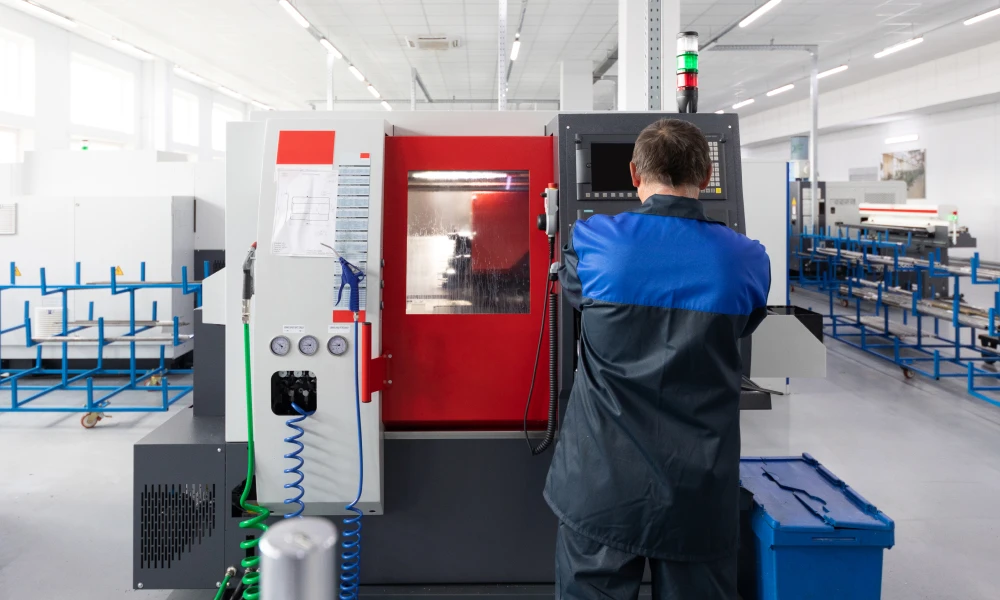
ERP software for CNC and machine tool manufacturing is a connected system that manages job order costing, machine-wise production scheduling and utilisation tracking, tooling and fixture management, raw material and component inventory, dimensional inspection records, and GST-compliant billing replacing the manual combination of paper job travellers, Excel machine schedules, and Tally billing that most Indian CNC job shops and machine tool manufacturers currently use.
For an Indian CNC machining business or machine tool manufacturer whether you run a precision job shop, manufacture lathes and milling machines, or produce precision components for OEMs ERP means: when a customer job order is confirmed, the system calculates material and machine time requirements, schedules the job across available machines, tracks the tooling and programme used, records dimensional inspection results, and generates a GST invoice on dispatch all from one connected platform.
The short answer: CNC and machine tool ERP connects your job order intake to your shop floor, your machine schedule to your quality lab, and your dispatch to your billing replacing the manual coordination that currently makes every job a separate costing and scheduling exercise.
Why Do CNC and Machine Tool Manufacturers in India Struggle Without ERP?
Indian CNC job shops and machine tool manufacturers operate with a level of precision and job-order variability that generic manufacturing ERP and accounting software cannot adequately support. Machine-wise costing, tooling management, and dimensional quality documentation create complexity unique to this industry.
Machine utilisation and job costing is not tracked accurately. Every CNC job consumes specific machine time and machine time is the single largest cost driver in precision manufacturing. Without systematic tracking of actual machine hours per job, manufacturers cannot accurately price future similar jobs or identify which machines are underutilised versus overbooked.
Tooling and programme management is informal. Each job may require specific cutting tools, fixtures, and CNC programme files. Without a system linking tooling and programmes to specific customer jobs, operators waste time searching for the right tool or recreating programmes that already exist and tool wear/replacement cycles go untracked.
Job costing does not account for setup time versus run time. Precision manufacturing costs include both machine setup time (often significant for small-batch or one-off jobs) and actual cutting/machining run time. Manual costing frequently conflates these, leading to inaccurate quotes for repeat versus new setup jobs.
Dimensional inspection records are on paper. Precision components require dimensional inspection often with CMM (Coordinate Measuring Machine) or manual gauge measurement documented per job or per batch. Paper inspection records make retrieval for customer complaints or ISO/IATF audits slow and unreliable.
Raw material costing for precision components is inaccurate. Material costs (bar stock, castings, forgings) plus significant machining waste (chips, scrap from facing/turning operations) need accurate tracking to determine true job profitability something manual systems rarely capture correctly.
GST on machine tools and precision components multiple rates and export considerations. Machine tools and precision components attract 18% GST domestically, but many Indian precision manufacturers export to global OEMs, requiring correct export GST treatment alongside domestic billing a dual compliance requirement most manual systems handle poorly.
Difference Between ERP and Accounting Software
Best ERP for manufacturing in India
How Does ERP Solve the Specific Problems of CNC and Machine Tool Manufacturers?
Can ERP Track Machine-Wise Job Costing and Utilisation?
Yes. CNC manufacturing ERP records actual machine time per job separating setup time from run time and calculates true job cost based on machine hourly rate, material consumed, and tooling cost. Machine utilisation reports show which machines are running at capacity and which have available time, supporting better job scheduling and future capacity planning decisions.
Manufacturing ERP 10 factory problems solved
Does ERP Manage Tooling and CNC Programme Files Per Job?
Yes. Tooling and programme registers in the ERP link specific cutting tools, fixtures, and CNC programme file references to customer jobs and part numbers. On repeat orders, the system identifies existing tooling and programmes automatically saving setup time and preventing unnecessary tool re-procurement or programme re-creation.
Can ERP Separate Setup Time from Run Time in Job Costing?
Yes. Job cost records in the ERP capture setup time and run time as distinct cost components enabling accurate quoting for new setup jobs versus repeat jobs using existing tooling and programmes, where setup cost is significantly reduced or eliminated.
Does ERP Record Dimensional Inspection Results?
Yes. Inspection results whether from CMM measurement or manual gauging are recorded per job or batch in the ERP, with pass/fail against drawing tolerances. This creates a digital inspection record that supports customer complaint investigation and ISO/IATF audit requirements without searching through paper files.
Best inventory management software for small business India
Can ERP Calculate Accurate Material Cost Including Machining Waste?
Yes. Raw material consumption per job bar stock, castings, forgings is tracked against actual finished part weight, with machining waste (chips, scrap) calculated and valued. This gives manufacturers a true material cost per job rather than an estimate that ignores waste.
Does ERP Handle GST for Both Domestic and Export Precision Component Sales?
Yes. Domestic sales apply standard 18% GST with correct HSN codes, while export sales are handled under LUT or with IGST payment for refund claim both managed within the same ERP, giving precision manufacturers serving both domestic OEMs and export customers one consistent billing system.
ERP for import export business India export compliance framework
What Features Should ERP for CNC and Machine Tool Manufacturing Include?
1. Job Order Costing with Setup and Run Time Separation
Job-wise cost calculation distinguishing setup time from machining run time enabling accurate quoting for new versus repeat jobs and true job profitability analysis.
2. Machine-Wise Scheduling and Utilisation Tracking
Production scheduling across available machines with real-time utilisation visibility helping production planners avoid bottlenecks and identify underutilised capacity.
3. Tooling and Fixture Register
A dedicated register linking cutting tools, fixtures, and CNC programme files to specific customer jobs and part numbers with tool wear tracking and replacement scheduling.
4. Dimensional Inspection and Quality Records
Digital recording of inspection results (CMM or manual gauge measurement) per job or batch with pass/fail against drawing specifications and certificate generation for customer quality documentation.
5. Material Consumption with Waste Tracking
Raw material (bar stock, castings, forgings) consumption tracked against finished part output with machining waste calculated and valued for accurate job costing.
6. GST-Compliant Billing for Domestic and Export Sales
Correct HSN codes and GST treatment for both domestic 18% GST billing and export sales under LUT or IGST refund claim in one system.
ERP software with GST billing for small manufacturers
7. Customer Drawing and Specification Management
Digital storage and version control for customer drawings, specifications, and approved sample records linked to job orders for accurate production reference.
8. Job-Wise Profitability Analysis
Real-time cost tracking per job material, machine time, tooling, and labour compared against sale price for immediate profitability visibility on every completed job.
9. Vendor Management for Raw Material and Outsourced Processes
Bar stock, casting, and forging supplier management plus tracking for outsourced processes like heat treatment, plating, or coating that many precision jobs require.
10. Cloud-Based Dashboard for Job Status
Live production status across all active jobs accessible from any device giving sales teams accurate delivery commitments and management real-time shop floor visibility.
Why Indian SMEs are moving to cloud ERP
CNC and Machine Tool ERP vs Standard Manufacturing ERP: Key Differences
| Requirement | Standard Manufacturing ERP | CNC & Machine Tool ERP |
|---|---|---|
| Cost basis | Product-wise standard cost | Job-wise, setup vs run time |
| Machine tracking | Not typically detailed | Machine-wise utilisation essential |
| Tooling management | Not standard | Tool/fixture/programme register |
| Quality documentation | Optional | Dimensional inspection per job |
| Material waste tracking | Standard percentage | Job-specific machining waste |
| Repeat job handling | Standard reorder | References existing tooling/programme |
| Export and domestic billing | Domestic-focused | Dual GST treatment for both |
Which Types of CNC and Machine Tool Businesses Benefit Most from ERP?
CNC machining job shops : variable job orders across multiple customers, machine-wise costing, and tooling reuse tracking for repeat business.
Machine tool manufacturers (lathes, milling machines, grinding machines) : production planning for complex assemblies, component-level BOM management, and OEM-standard quality documentation.
Precision component manufacturers for automotive and aerospace OEMs : IATF/AS9100-aligned quality documentation, dimensional inspection records, and OEM-specific part traceability.
ERP for auto parts business India automotive supply chain context
Tool room and die-making operations : die and mould manufacturing with long-cycle job tracking, precision inspection, and customer approval workflow management.
Sheet metal and fabrication shops with CNC operations : combined CNC machining and fabrication process tracking with material nesting and waste optimisation.
Export-oriented precision manufacturers : serving global OEM customers with dual domestic-export GST compliance and international quality standard documentation.
ERP for import export business India
How Much Time Does ERP Save for an Indian CNC or Machine Tool Manufacturer?
| Task | Without ERP | With CNC Manufacturing ERP |
|---|---|---|
| Job costing with setup/run time | 30–45 min manual estimation | Under 10 minutes |
| Tooling/programme lookup for repeat job | Manual search, often missed | Instant system lookup |
| Machine utilisation analysis | Manual, monthly or never | Real-time dashboard |
| Dimensional inspection record per job | Paper filing, hard to retrieve | Digital, instant retrieval |
| Job-wise profitability calculation | Manual, end of month | Automatic, real-time |
| GST billing (domestic + export) | Manual per transaction type | Automatic per customer type |
| Monthly material waste analysis | Rarely done manually | Automatic per job |
For a CNC job shop or machine tool manufacturer processing 30–100 jobs per month, this saves approximately 30–40 hours monthly in job costing, scheduling, and quality documentation work.
See real ERP ROI for Indian SMEs
Why Rajkot Is a Major Hub for CNC and Machine Tool Manufacturing
Rajkot’s engineering ecosystem already established as India’s leading centre for pump manufacturing, auto components, and precision engineering goods is also home to a significant cluster of CNC machining job shops and machine tool manufacturers supplying both domestic OEMs and international export markets.
Despite this precision manufacturing capability, most Rajkot CNC and machine tool businesses still manage job costing, tooling, and quality documentation manually paper job travellers, Excel machine schedules, and disconnected inspection records while their OEM and export customers increasingly demand digital traceability, ISO/IATF-aligned documentation, and GST e-invoicing compliance.
The precision manufacturers who adopt ERP first gain a measurable advantage faster and more accurate job quoting, better machine utilisation, and quality documentation that supports both domestic OEM qualification and export customer requirements.
Why Apna ERP Is the Right Choice for Indian CNC and Machine Tool Manufacturers
Apna ERP is a cloud-based ERP built for Indian manufacturing SMEs including CNC job shops and machine tool manufacturers with the job-order costing, machine utilisation, and precision quality documentation requirements that generic accounting software cannot handle.
Job-wise costing with setup and run time. Accurate quoting and profitability analysis distinguishing setup cost from machining run time critical for job-shop pricing accuracy.
Tooling and programme management. Cutting tools, fixtures, and CNC programme files linked to customer jobs enabling fast, accurate repeat job setup.
Machine utilisation tracking. Real-time visibility into which machines are running at capacity and which have available time supporting better scheduling decisions.
Dimensional quality documentation. Digital inspection records per job replacing paper filing and supporting ISO/IATF audit requirements.
Dual GST compliance. Domestic 18% GST billing and export GST treatment (LUT/IGST refund) in one system serving both OEM and international customers.
Local Rajkot support team. Based in Rajkot in the heart of India’s precision engineering manufacturing belt with a team that understands CNC and machine tool manufacturing operations.
How to Implement ERP in Your CNC or Machine Tool Manufacturing Business
Step 1: Build Your Machine and Tooling Masters
Enter all machines with their hourly rates and capacity, and create a tooling register for existing cutting tools, fixtures, and CNC programmes with their associated jobs or customers.
Step 2: Configure Job Costing Parameters
Set up standard rates for machine time (setup and run separately), material costing methods, and labour allocation forming the basis for accurate job quotations.
Step 3: Set Up Quality Inspection Parameters
Define dimensional inspection checkpoints and tolerance parameters per part type or customer requirement so QC pass/fail is recorded systematically against drawing specifications.
Step 4: Configure GST Settings for Domestic and Export Sales
Set up domestic customer billing at standard GST rates and export customer billing under LUT or IGST refund treatment as applicable to your customer mix.
Step 5: Train Production, Quality, and Sales Teams
Production supervisors need training on job order entry and machine time recording. Quality staff need training on inspection result entry. Sales team needs training on job costing and quotation generation from the system.
Full step-by-step ERP implementation guide
Frequently Asked Questions
What is ERP software for CNC and machine tool manufacturing in India?
It is a connected system managing job-order costing with setup and run time separation, machine-wise scheduling and utilisation tracking, tooling and CNC programme management, dimensional inspection records, and GST billing for both domestic and export sales replacing the manual paper job travellers, Excel machine schedules, and Tally billing used by most Indian CNC job shops and machine tool manufacturers.
Can ERP track machine utilisation for CNC operations?
Yes. CNC manufacturing ERP records actual machine time per job and generates utilisation reports showing which machines are running at capacity and which have available time supporting better scheduling and future capacity investment decisions.
How does ERP help manage tooling and CNC programme files for repeat jobs?
ERP maintains a tooling and programme register linking specific cutting tools, fixtures, and programme files to customer jobs and part numbers. On repeat orders, the system identifies existing tooling automatically, saving setup time and preventing unnecessary programme recreation.
Can ERP separate setup time from run time in job costing?
Yes. This distinction is critical for accurate job-shop pricing ERP captures setup time and machining run time as separate cost components, enabling accurate quotes for new setup jobs versus repeat jobs using existing tooling.
Does ERP support dimensional inspection documentation for precision parts?
Yes. Inspection results from CMM or manual gauge measurement are recorded per job or batch, with pass/fail against drawing tolerances creating a digital, retrievable inspection record for customer complaint investigation and ISO/IATF audit compliance.
Is ERP affordable for a small CNC job shop in India?
Yes. Cloud-based ERP for CNC and machine tool manufacturers is priced on a monthly subscription with no server hardware cost. See ERP pricing for Indian MSMEs →
Can ERP handle both domestic and export billing for precision manufacturers?
Yes. Domestic sales apply standard 18% GST with correct HSN codes, while export sales are handled under LUT or with IGST payment for refund claim both managed within the same ERP for manufacturers serving both domestic OEMs and international customers.
Which ERP is best for CNC and machine tool manufacturers in Rajkot in 2026?
The best ERP for Rajkot CNC and machine tool manufacturers combines job-wise costing with setup/run time separation, tooling management, dimensional quality documentation, and dual domestic-export GST compliance with local support from a team based in Rajkot’s precision engineering hub. Apna ERP is built for exactly this. Compare ERP companies
 15 Oct, 2026